THE TITLES AREN'T A FORMALITY. THEY'RE A PROMISE.
We built the opening and closing titles for Bedlam, Blackwater Pictures' 18th-century martial arts thriller directed by Jon Shaikh. Here's what it means to work inside someone else's vision, not alongside it.
A different kind of brief
Most of our work starts with a blank page and a brand that doesn't exist yet. This one started differently — with a film already shot, a world already built, and a director's vision we had no part in creating. The job wasn't to invent something new. It was to earn our place inside something that already had its own energy, its own rules, its own London. That's a harder brief than it sounds. You're not designing in service of an idea you came up with. You're designing in service of someone else's, and the work only succeeds if the audience can't tell where the film ends and the titles begin.
Inside Bedlam's world
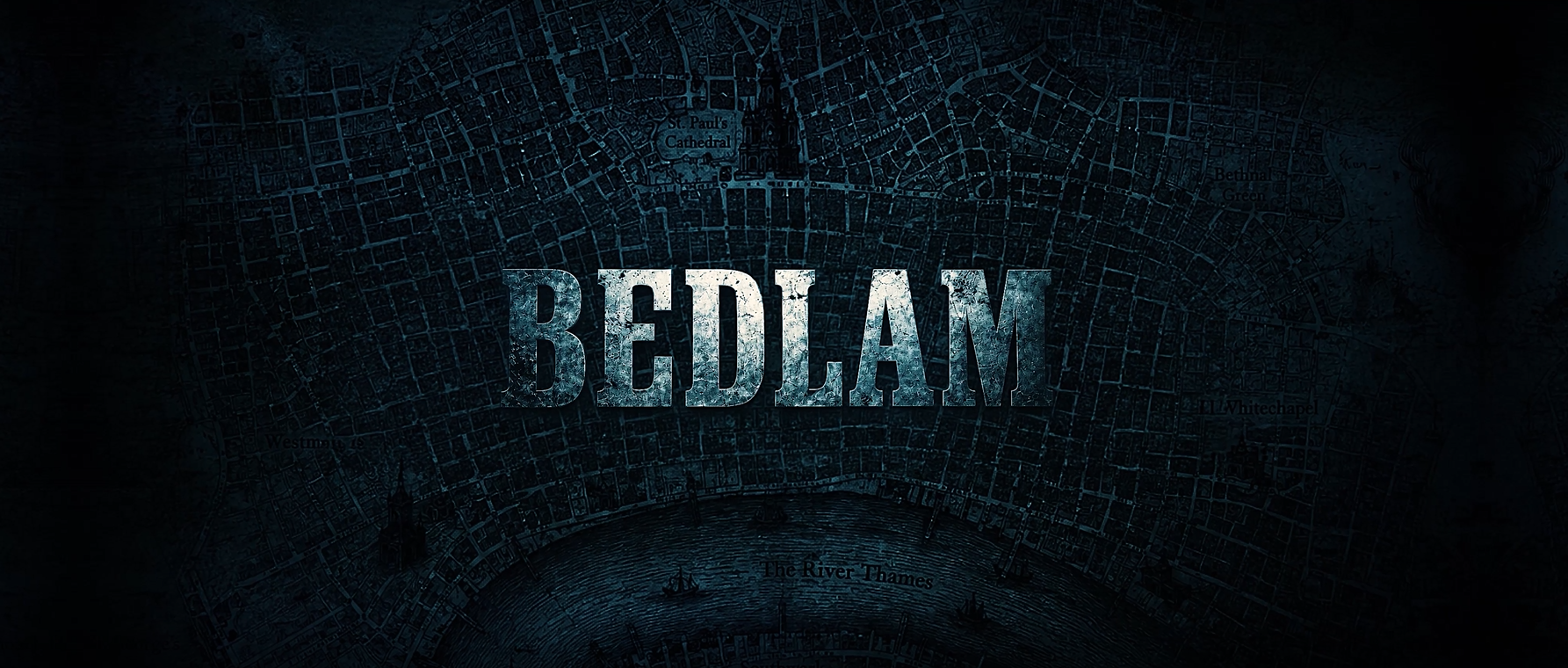
Bedlam is an 18th-century martial arts thriller starring Scott Adkins as a street boxer who infiltrates London's notorious Bedlam asylum to rescue his wrongfully imprisoned sister. Our job was to establish the tone, era and geography of that world in the opening minute, then bookend the film with a closing sequence that sends audiences out remembering who they'd just spent two hours with. We composited period engravings, hand-drawn maps and blood-spattered typography into a kinetic title system — not decoration over the film, but the audience's first handshake with it.
What you see when you're that close to it
We saw first-hand the time, energy and passion that goes into making an action-packed thriller set in 1700s London — the research into period detail, the physicality Scott Adkins and the team brought to every sequence, Jon Shaikh's precision about tone from the very first frame. Once you're that close to a production, you feel an obligation to match its intensity rather than sit politely alongside it. That energy had to come through in typography and motion just as much as it came through on screen.
Synergy, not separation
This is the part of the job people underestimate: title design isn't a formality that happens after the film is finished. Done well, it's synergy — the same discipline, the same stakes, the same story, expressed through a different toolkit. Once you're in that space, even for a small part of the runtime, you're helping shape how an audience experiences the whole film. Not the loudest contribution, but a real one.
Where this goes next
We'd like to do more of this — working alongside independent studios and directors who are building something singular, not generic. If you're a filmmaker or production company who needs titles, credits or motion work that earns its place inside the world you've built rather than sitting on top of it, we'd like to be part of that conversation.
Want to talk it through?